
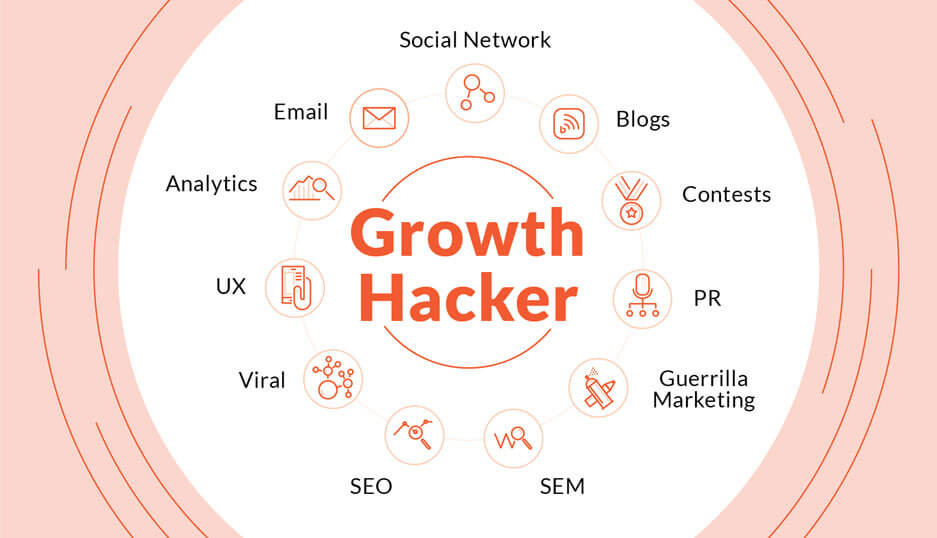
Growth hacking is a term that was overused into meaninglessness around 2015, but the underlying principle remains sound: use low-cost, data-driven experiments to find the fastest paths to success. The growth hacking techniques that produce repeatable results in 2025 are often less glamorous than viral case studies suggest, focusing instead on sustainable retention and meticulous optimization.
The distinction that separates growth tactics from growth strategy: one-time tactics spike the numbers and fade. Growth loops compound. Everything below is designed around loops – where growth feeds more growth.
Core Growth Hacking Techniques: What They Are and Where They Work
| Technique | Stage | Mechanism | Real Example | Difficulty |
| Viral referral loop | Acquisition | Existing users recruit new users with incentive for both sides | Dropbox: 500MB free for each referral – grew 3,900% in 15 months | Medium – incentive design is everything |
| Product-led growth (PLG) | Acquisition + Retention | Free tier acquires users; product value converts them to paid | Notion, Figma, Slack – free enough to start, good enough to pay | High – requires product investment upfront |
| SEO content moat | Acquisition (long-term) | Publishing high-quality content at scale to capture organic search | HubSpot, Ahrefs – million-user audiences built on content alone | Medium – compounding results require 12-24 months |
| Community-led growth | Retention + Acquisition | Users build community around product; community recruits users | Notion’s template community, Figma’s plugins ecosystem | High – community culture is hard to manufacture |
| Optimised onboarding | Activation | Ensure new users reach the ‘aha moment’ before they churn | Slack’s 2,000 message threshold – teams who hit it almost never left | Medium – requires user research and A/B testing |
| Cold outreach at scale | Acquisition (B2B) | Personalised email sequences to ICP – not mass blast | Many early SaaS companies scaled from 0 to $1M ARR on cold email alone | Low-Medium – tools make scale easy; personalisation is the hard part |
| Retention before acquisition | Retention first | Fix the leaky bucket before pouring more water in | Improving D7 retention from 15% to 25% is worth more than doubling acquisition spend | High – requires deep product analytics |
The Activation Problem: Why Most Growth Fails Here
Most growth teams focus on acquisition – getting people to sign up or download. The real growth problem, in most products, is activation: getting new users to experience the core value before they leave.
The pattern is consistent across products: 40-60% of new users who sign up never return after the first session. The acquisition cost was paid; the value was never delivered. No amount of acquisition investment fixes a broken activation funnel.
- Define your product’s ‘aha moment’ – the specific action that strongly predicts long-term retention. For Slack it was 2,000 messages. For Twitter it was following 30+ accounts
- Map the steps between signup and that aha moment – each step is a potential drop-off point
- Remove every unnecessary step. Friction in onboarding is directly visible in activation rates
- Use in-app messaging, email sequences, and tooltips to guide users toward the moment – not just after signup
How Referral Programs Actually Work (and Why Most Fail)
Dropbox’s referral program is cited in every growth hacking article. Here’s what actually made it work – and why copying the mechanic without the underlying conditions usually fails:
- The incentive was in-product: More storage – the thing users already wanted more of. Not a discount on something they didn’t care about
- The incentive was bilateral: Both referrer and referred got the reward. One-sided programs produce resentment in the referrer and suspicion in the referred
- The product was already good enough: Referral programs amplify existing word-of-mouth; they don’t create it. Dropbox’s referral success was built on a product people genuinely wanted to share
- The friction was near-zero: Share via email, link, or social – the program required one click
SEO as a Compounding Growth Channel
Search traffic compounds in a way paid acquisition doesn’t: content published today continues generating traffic for years without additional spend. The mechanism:
- Identify high-volume, low-competition keywords in your product’s domain using Ahrefs, Semrush, or similar
- Create genuinely useful content that answers the question better than existing results – not thin content padded for word count
- Build topical authority by covering a domain comprehensively, not just individual keywords
- The compound effect: 50 high-quality articles at month 12 produces more traffic than 50 articles at month 1 because domain authority increases with time, backlinks, and engagement signals
Common Growth Hacking Mistakes
| Mistake | Why It Fails | What Works Instead |
| Optimising acquisition before fixing retention | You’re filling a leaky bucket – churn erases every gain | Benchmark D7 and D30 retention first; fix the floor before scaling |
| Copying tactics without understanding conditions | Dropbox’s referral worked for specific product/market reasons – those may not apply to you | Extract the principle, not the mechanic |
| Running too many experiments simultaneously | Can’t identify what caused what; learning is contaminated | One primary experiment at a time with statistical significance threshold |
| Treating growth as a marketing function only | Real growth (PLG, referral loops) sits in product – marketing amplifies, product creates | Embed growth thinking in product decisions from day one |
| Chasing viral spikes instead of retention loops | Viral moments without retention produce a spike-and-crash pattern in the metrics | Build loops that compound slowly rather than spikes that fade fast |
Early Stage vs. Scaling: Different Playbooks
Growth tactics that work at 1,000 users often fail at 100,000 – and vice versa:
- Early stage (0-10k users): Manual, unscalable things work best. Personal outreach, founder sales, community building one person at a time. Paul Graham’s “do things that don’t scale” is correct for this stage
- Growth stage (10k-1M users): Systematise what worked manually. Build referral infrastructure, invest in SEO, launch product-led free tiers, build onboarding sequences
- Scale (1M+ users): Distribution advantages compound. The moat is network effects, content, and community – all of which get stronger as you get bigger
Final Thought
The best growth hack is a product people genuinely want to tell other people about. Everything else – referral programs, SEO, onboarding optimisation – amplifies the signal that already exists. It cannot create signal where there is none. If growth experiments aren’t working, the question to ask first isn’t “which channel should we try next?” It’s “are people who use this product glad they found it?” The answer to that question determines whether growth is possible at all.