A house in the Coachella Valley that stays locked from May to October doesn’t really rest. The garage can pass 120 degrees by midafternoon, the attic gets hotter still, and any water left in the pipes, traps and tanks sits in that heat for five months. Owners usually notice something on their first evening back. It might be a sour smell near the guest bath, or a toilet that hisses and refills by itself at two in the morning.
Most of these problems are small, and they repeat from house to house. Seasonal homes in Palm Desert, Indian Wells, La Quinta and Rancho Mirage tend to show the same handful of issues each fall. The order in which you check them matters more than most people expect.
Some owners book a walk-through with a local family-owned shop such as Apple J Plumbing Inc., a licensed Palm Desert company that has handled service work, remodels and new construction around the valley for more than a decade. If you plan to do the first pass yourself, start with the parts of the plumbing that fail fastest in desert heat.
That Smell by the Front Door Usually Starts in a Drain
Every sink, tub and floor drain has a curved trap below it that holds a few inches of water. That water is the only thing keeping sewer gas out of the house. In dry desert air, an unused trap can evaporate within a few weeks, so by October several of them are often empty.
The rooms people use least dry out first. Look at the casita bath, the wet bar sink, the laundry floor drain and the shower in the guest room nobody stays in. Run water in each drain for about half a minute and flush every toilet twice. That refills the seals, and the odor normally clears within an hour.
If the smell stays after every trap is full, something else is wrong. A wax ring under a toilet can dry and shrink over a hot summer. A roof vent can also be partly blocked by a nest or debris. Dry traps also let roaches in from the sewer side, so an empty trap is a bigger issue than the smell alone.
Heat Is Hard on Rubber Parts
Copper and PEX handle a desert summer reasonably well. The soft parts attached to them don’t. Toilet flappers, fill valve seals, faucet cartridges and the washers inside braided supply lines all sit in warm, chlorinated water for months, and they tend to warp, stiffen or crack.
A warped flapper causes what plumbers call a phantom flush. The tank leaks slowly into the bowl until the fill valve kicks on for a few seconds, with no one touching the handle. To check, put a few drops of food coloring in the tank and wait twenty minutes without flushing. If the color shows up in the bowl, the flapper needs to be replaced. It is one of the cheapest repairs in the house.
The water meter can tell you about leaks you can’t see. With every fixture off, write down the reading, or watch the small leak indicator on the dial. Check again after an hour or two. If the number moved and no one used water, there is a leak somewhere.
Turning the Water Back On Without Shocking the System
Many owners close the main valve before leaving, which is a sensible precaution. Opening it again calls for some care, because air and loose mineral scale have been sitting in the lines. A gradual restart avoids most problems.
- Unscrew the faucet aerators in the kitchen and bathrooms first. Flakes of scale knocked loose by the returning water will collect there, and an aerator is easier to clean than a cartridge.
- Open the main valve a quarter turn and wait while the lines fill. Opening it fully in one go sends a pressure surge through old fittings.
- Open the faucet farthest from the main and let it sputter until the flow is smooth. Then work back toward the main one fixture at a time.
- Fill the water heater completely before relighting it or switching the power back on. An electric element that heats an empty tank burns out within seconds.
- Look under every sink and behind the washer while the system comes up to full pressure. A dried supply line is most likely to fail in the first few minutes.
The Water Heater Sat in the Hottest Room
In many desert homes the water heater is in the garage, which is about the worst place to store anything over a summer. Water left in a tank for months can develop a rotten-egg odor. That happens when the anode rod reacts with bacteria in water that hasn’t moved. Draining the tank and refilling it usually fixes it. If the odor comes back, the anode may need to be replaced.
Sediment matters here as well. Valley water comes from a large underground aquifer, and the minerals in it settle to the bottom of the tank over time. The Coachella Valley Water District publishes annual water quality reports with hardness figures for different parts of the valley, so you can see what your own tap water contains. A popping or rumbling sound as the burner heats means a layer of sediment has built up and the tank should be flushed.
While you are there, lift the lever on the temperature and pressure relief valve briefly to make sure it opens and closes properly. If the house has a pressure regulator, check the expansion tank too. A tank that has filled with water can no longer absorb thermal expansion, and that extra pressure eventually wears out faucets and toilet valves. Tankless units need attention as well. Hard water scales their heat exchangers, and a descaling flush each fall keeps them working properly.
Under the Floor and Out in the Yard
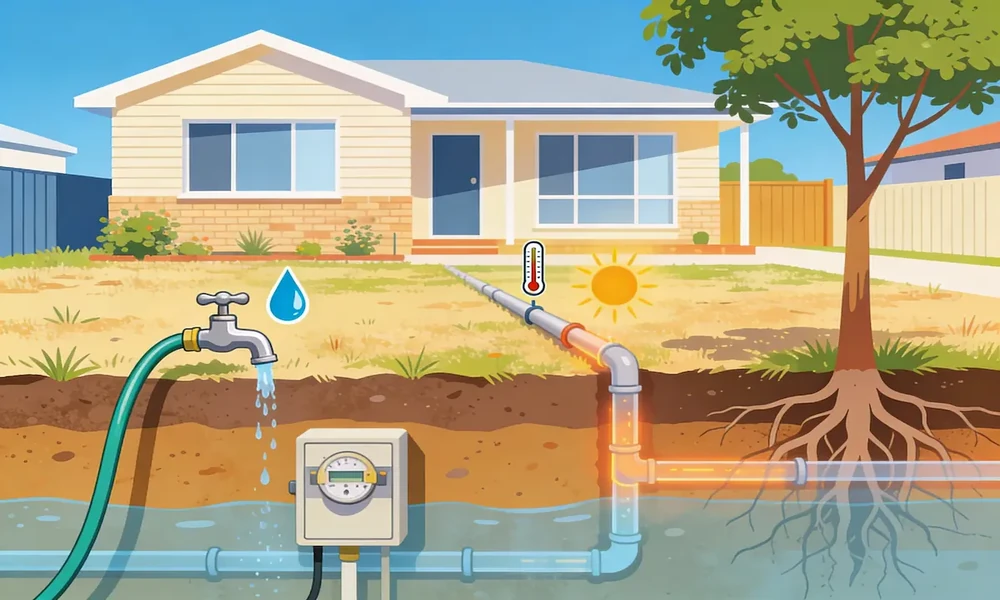
Some leaks are hard to spot because they happen in places you rarely look. In older valley homes, hot water lines often run through the concrete slab. A pinhole in one of those lines can show up as a warm patch on tile, the sound of running water behind a wall, or a meter that keeps moving when the house is shut down.
Your summer water bills are another place to look. If the landscapers watered all summer, compare the bills against the same months in earlier years. A large jump can point to a cracked drip line, a backflow preventer that leaked after a monsoon storm, or a pool auto-fill valve that ran continuously to replace water lost through a crack.
Planning Ahead for Next May
The best time to prepare for next summer is the week before you leave. A spoonful of mineral oil poured into rarely used drains floats on the trap water and slows evaporation a great deal. Gas water heaters have a vacation setting that keeps the pilot lit while holding the tank only lukewarm. A battery-powered leak sensor under each sink costs very little compared with water damage that goes unnoticed for months.
Owners who keep the water on through the summer often install a smart shutoff valve that closes on its own when it detects unusual flow. A house watcher who stops by every couple of weeks to run each tap and flush each toilet also helps a lot. It keeps the traps full and the rubber parts wet. In a valley where the house sits empty through the hottest months, that bit of attention in summer means far fewer problems to deal with in October.